
| CAD 模型: | View CAD Model |
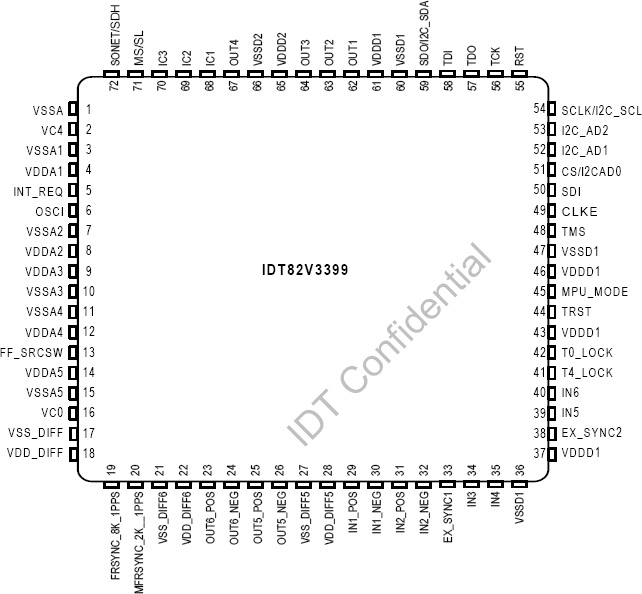
| Pkg. Type: | VFQFPN |
| Pkg. Code: | NLG72 |
| Lead Count (#): | 72 |
| Pkg. Dimensions (mm): | 10.0 x 10.0 x 1.0 |
| Pitch (mm): | 0.5 |
| Pb (Lead) Free | Yes |
| ECCN (US) | EAR99 |
| HTS (US) | 8542.39.0090 |
| Moisture Sensitivity Level (MSL) | 3 |
| Pkg. Type | VFQFPN |
| Lead Count (#) | 72 |
| Pb (Lead) Free | Yes |
| Carrier Type | Tray |
| Assembly Location | TAIWAN |
| Wafer Fab Location | TAIWAN |
| Advanced Features | Full SETS (ITU-T G.8264), Hitless Reference Switching, External Sync Input |
| App Jitter Compliance | GR-1244-CORE, GR-253-CORE, ITU-T G.812, ITU-T G.8262. ITU-T G.813, ITU-T G.783, Stratum 3, 4E, 4, SMC, EEC-Option 1, EEC-Option 2 Clocks |
| Application | System Synchronizer |
| Channels (#) | 2 |
| Clock Support | G.813 Opt 1, G.813 Opt 2, G.8262 Opt 1, G.8262 Opt 2, GR-1244-CORE Stratum 4, GR-1244-CORE Stratum 4E, GR-1244-CORE Stratum 3, GR-253-CORE SONET Minimum Clock, GR-253-CORE SONET Stratum 3 |
| Core Voltage (V) | 3.3 |
| Diff. Inputs | 2 |
| Diff. Outputs | 2 |
| Input Freq (MHz) | 1.0E-6 - 625 |
| Input Freq Range Type | 1PPS (1 Hz), TDM, DS1, E1, SONET/SDH, Ethernet, Sync Pulse |
| Input Type | LVPECL, LVDS, LVCMOS |
| Inputs (#) | 6 |
| Length (mm) | 10 |
| MOQ | 168 |
| Moisture Sensitivity Level (MSL) | 3 |
| Output Banks (#) | 8 |
| Output Freq Range (MHz) | 1.0E-6 - 644.531 |
| Output Freq Range Type | 1PPS (1 Hz), TDM, DS1, E1, DS2, E3, DS3, 100BASE-T, STM-1/OC-3, STM-4/OC-12, 1000BASE-T/X |
| Output Skew (ps) | 150 |
| Output Type | LVPECL, LVDS, LVCMOS |
| Output Voltage (V) | 3.3 |
| Outputs (#) | 8 |
| Package Area (mm²) | 100 |
| Pb Free Category | e3 Sn |
| Phase Jitter Typ RMS (ps) | 0.8 |
| Pitch (mm) | 0.5 |
| Pkg. Dimensions (mm) | 10.0 x 10.0 x 1.0 |
| Prog. Clock | Yes |
| Prog. Interface | I2C, Serial, JTAG |
| Qty. per Carrier (#) | 168 |
| Qty. per Reel (#) | 0 |
| Reference Output | Yes |
| Requires Terms and Conditions | Does not require acceptance of Terms and Conditions |
| Spread Spectrum | No |
| Tape & Reel | No |
| Temp. Range (°C) | 0 to 70°C |
| Thickness (mm) | 1 |
| Width (mm) | 10 |
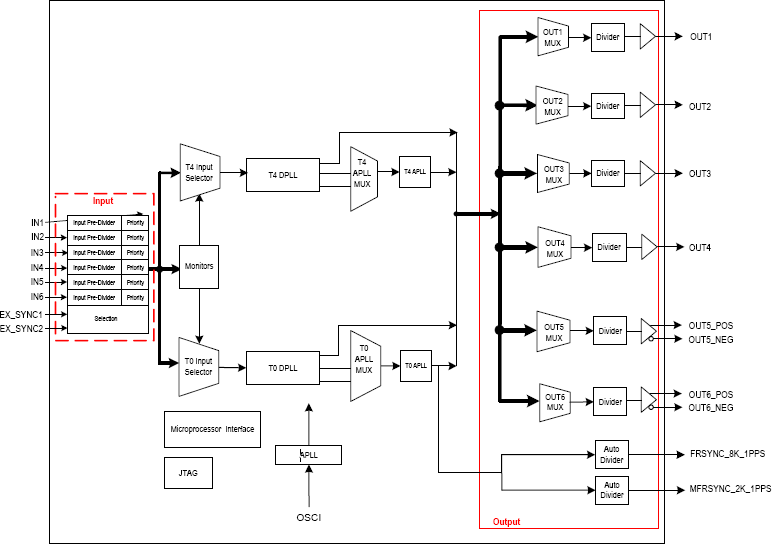
The 82V3399 is an integrated, single-chip solution for the Synchronous Equipment Timing Source for Stratum 3, 4E, 4, SMC, EECOption1, EEC-Option2 clocks in SONET / SDH / Synchronous Ethernet equipment, DWDM and Wireless base station. The device supports several types of input clock sources: recovered clock from Synchronous Ethernet, STM-N or OC-n, PDH network synchronization timing and external synchronization reference timing. The device consists of T0 and T4 paths. The T0 path is a high quality and highly configurable path to provide system clock for node timing synchronization within a SONET / SDH / Synchronous Ethernet network. The T4 path is simpler and less configurable for equipment synchronization. The T4 path locks independently from the T0 path or locks to the T0 path. An input clock is automatically or manually selected for T0 and T4 path. Both the T0 and T4 paths support three primary operating modes: Free-Run, Locked and Holdover. In Free-Run mode, the DPLL refers to the master clock. In Locked mode, the DPLL locks to the selected input clock. In Holdover mode, the DPLL resorts to the frequency data acquired in Locked mode. Whatever the operating mode is, the DPLL gives a stable performance without being affected by operating conditions or silicon process variations. There are 2 high performance APLLs that can be used for low jitter SONET and Ethernet Clocks The device provides programmable DPLL bandwidths: 0.5 mHz to 560 Hz in 19 steps and damping factors: 1.2 to 20 in 5 steps. Different settings cover all SONET / SDH clock synchronization requirements. A highly stable input is required for the master clock in different applications. The master clock is used as a reference clock for all the internal circuits in the device. It can be calibrated within ±741 ppm. All the read/write registers are accessed through a microprocessor interface. The device supports I2C and serial microprocessor interface modes. In general, the device can be used in Master/Slave application. In this application, two devices should be used together to enable system protection against single chip failure.