
| CAD 模型: | View CAD Model |
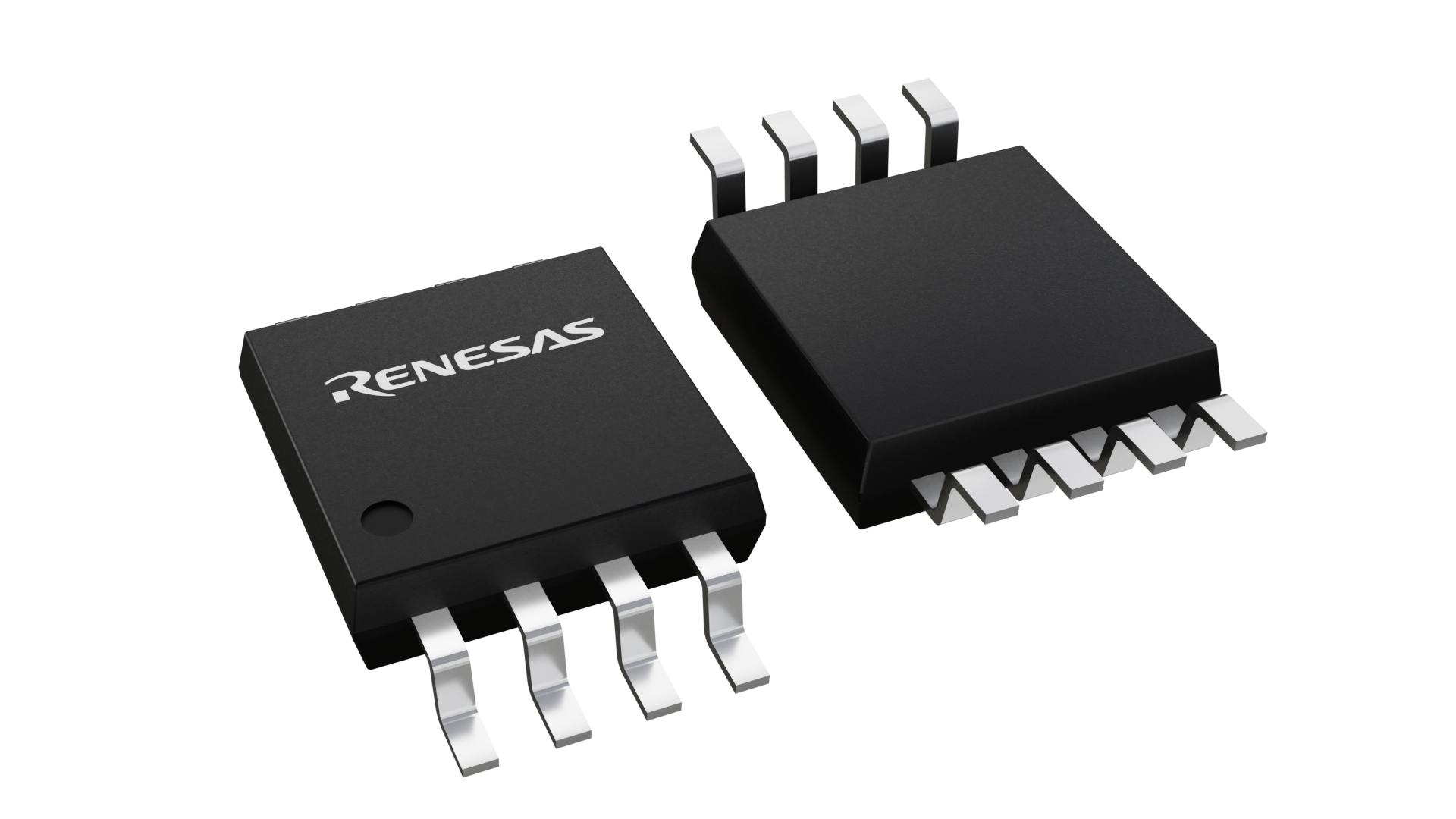
| Pkg. Type: | MSOP |
| Pkg. Code: | MRK |
| Lead Count (#): | 8 |
| Pkg. Dimensions (mm): | 3.0 x 3.0 x 0.00 |
| Pitch (mm): | 0.7 |
| Moisture Sensitivity Level (MSL) | 2 |
| ECCN (US) | EAR99 |
| HTS (US) | 8542.39.0090 |
| RoHS (X9313ZMZ-3) | 下载 |
| Pb (Lead) Free | Yes |
| Carrier Type | Tube |
| Moisture Sensitivity Level (MSL) | 2 |
| Country of Assembly | MALAYSIA, THAILAND |
| Country of Wafer Fabrication | USA |
| Advanced Features | Integrated charge pump to allow for single supply to swing -5.5V to 5.5V |
| Channels (#) | 1 |
| End-to-End Temperature Coefficient (ppm/°C) | 300 |
| Interface | 3-Wire (Up/Down) |
| Lead Count (#) | 8 |
| Length (mm) | 3 |
| MOQ | 960 |
| Memory Type | Nonvolatile |
| Middlepoint Ratiometric Tempco | 20 |
| Pb (Lead) Free | Yes |
| Pb Free Category | Pb-Free 100% Matte Tin Plate w/Anneal-e3 |
| Pitch (mm) | 0.7 |
| Pkg. Dimensions (mm) | 3.0 x 3.0 x 0.00 |
| Pkg. Type | MSOP |
| Price (USD) | $4.22125 |
| Qualification Level | Standard |
| Resistance Options (kΩ) | 1 |
| Resistance Taper | Linear |
| Supply Current Icc (µA) | 200 |
| Supply Voltage Vcc (Min) (V) | 3 |
| Taps (#) | 32 |
| Temp. Range (°C) | 0 to +70°C |
| VL Terminal Voltage (Max) (V) | 5.5 |
| VL Terminal Voltage (Min) (V) | -5.5 |
| Vcc (V) | 3.0 to 5.5 |
| Width (mm) | 3 |
| Wiper Current (mA) | 4.4 |
| Wiper Resistance (ohms) | 40 |
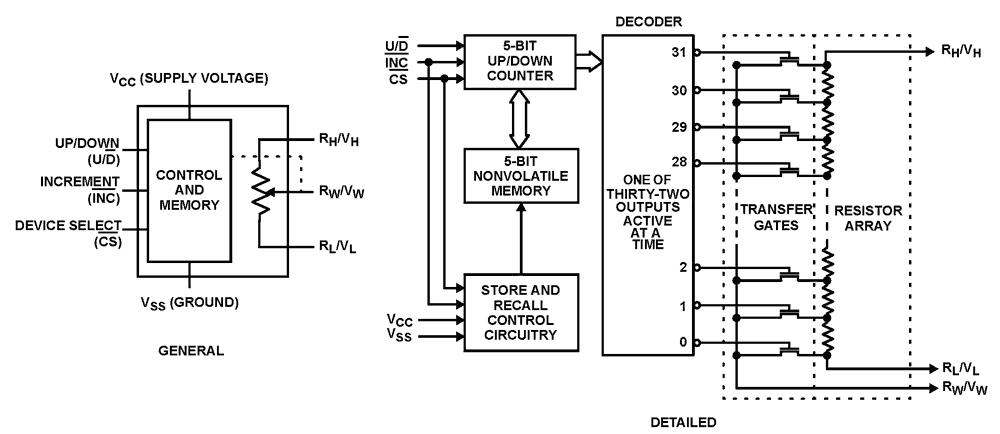
The Intersil X9313 is a digitally controlled potentiometer (XDCP). The device consists of a resistor array, wiper switches, a control section, and nonvolatile memory. The wiper position is controlled by a 3-wire interface. The potentiometer is implemented by a resistor array composed of 31 resistive elements and a wiper switching network. Between each element and at either end are tap points accessible to the wiper terminal. The position of the wiper element is controlled by the CS, U/D, and INC inputs. The position of the wiper can be stored in nonvolatile memory and then be recalled upon a subsequent power-up operation. The device can be used as a three-terminal potentiometer or as a two-terminal variable resistor in a wide variety of applications including:
