
| CAD 模型: | View CAD Model |
| Pkg. Type: | CDIP |
| Pkg. Code: | CD6 |
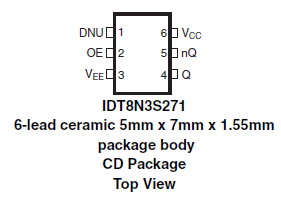
| Lead Count (#): | 6 |
| Pkg. Dimensions (mm): | 7.0 x 5.0 x 1.5 |
| Pitch (mm): | 2.57 |
| Moisture Sensitivity Level (MSL) | 1 |
| Pb (Lead) Free | Yes |
| ECCN (US) | EAR99 |
| HTS (US) | 8542.39.0090 |
| Lead Count (#) | 6 |
| Carrier Type | Reel |
| Moisture Sensitivity Level (MSL) | 1 |
| Freq. Accuracy Init. (± PPM) | 50 |
| Qty. per Reel (#) | 1000 |
| Qty. per Carrier (#) | 0 |
| Pb (Lead) Free | Yes |
| Pb Free Category | e4 Au |
| Temp. Range (°C) | -40 to 85°C |
| Abs. Pull Range Min. (± PPM) | 100 |
| C-C Jitter Max P-P (ps) | 30 |
| Core Voltage (V) | 2.5V, 3.3V |
| Family Name | FemtoClock NG |
| Feedback Input | No |
| Freq. Accuracy Temp. (± PPM) | 20 |
| Freq. Stability Total (± PPM) | 33 |
| Function | XO |
| Length (mm) | 7 |
| MOQ | 1000 |
| Output Banks (#) | 1 |
| Output Freq Range (MHz) | 15.476 - 866.67, 975 - 1300 |
| Output Signaling | LVPECL |
| Output Type | LVPECL |
| Output Voltage (V) | 2.5V, 3.3V |
| Outputs (#) | 1 |
| Package Area (mm²) | 35 |
| Period Jitter Max P-P (ps) | 2.8 |
| Period Jitter Typ P-P (ps) | 1.9 |
| Phase Jitter Max RMS (fs) | 882 |
| Phase Jitter Max RMS (ps) | 0.882 |
| Phase Jitter Typ RMS (fs) | 497 |
| Phase Jitter Typ RMS (ps) | 0.497 |
| Pitch (mm) | 2.57 |
| Pkg. Dimensions (mm) | 7.0 x 5.0 x 1.5 |
| Pkg. Type | CDIP |
| Product Category | Crystal Oscillators |
| Prog. Clock | No |
| Reel Size (in) | 13 |
| Requires Terms and Conditions | Does not require acceptance of Terms and Conditions |
| Supply Voltage (V) | 2.5 - 2.5, 3.3 - 3.3 |
| Tape & Reel | Yes |
| Thickness (mm) | 1.5 |
| VCO Max Freq (MHz) | 2600 |
| VCO Min Freq (MHz) | 1950 |
| Width (mm) | 5 |
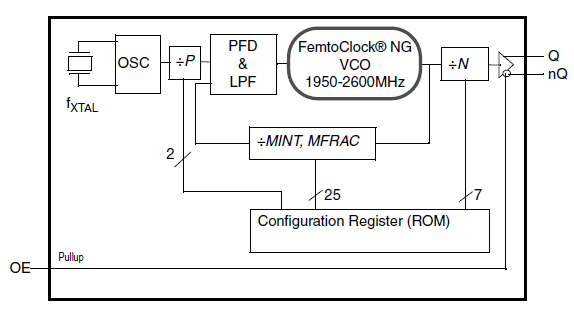
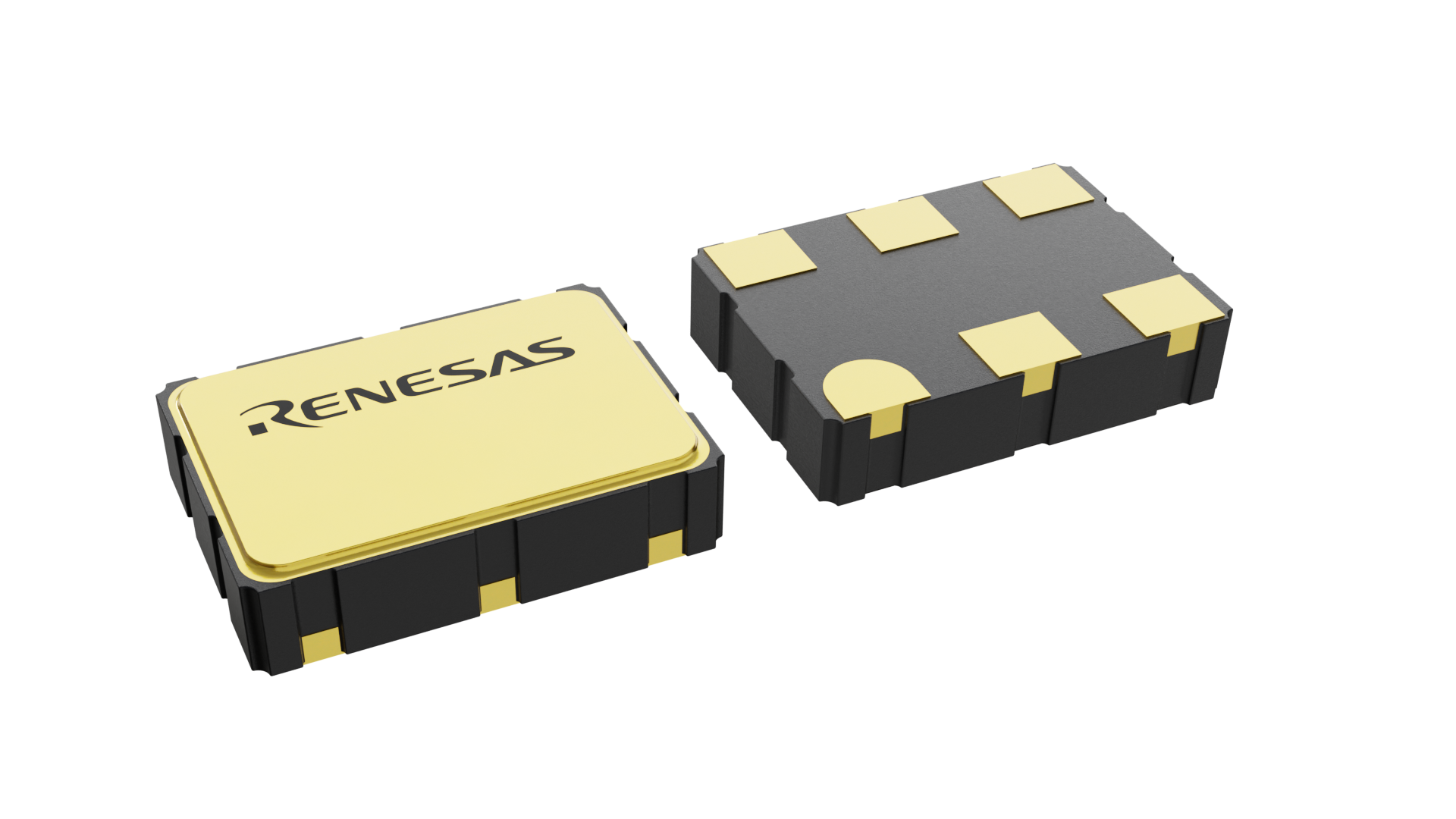
The 8N3S271 is a Frequency-Programmable Crystal Oscillator with very flexible frequency programming capabilities. The device uses IDT's fourth generation FemtoClock® NG technology for an optimum of high clock frequency and low phase noise performance (<0.5 ps RMS 12kHz - 20MHz). The device accepts 2.5V or 3.3V supply and is packaged in a small, lead-free (RoHS 6) 6-lead ceramic 5mm x 7mm x 1.55mm package. The device can be programmed to any in the range from 15.476MHz to 866.67MHz and from 975MHz to 1,300MHz and supports a very high degree of frequency precision of 218 Hz or better. The extended temperature range supports wireless infrastructure, telecommunication and networking end equipment requirements.
