
封装信息
| CAD 模型: | View CAD Model |
| Pkg. Type: | CQFP |
| Pkg. Code: | RNZ |
| Lead Count (#): | 48 |
| Pkg. Dimensions (mm): | 10.0 x 10.0 x 0.00 |
| Pitch (mm): | 0.6 |
环境和出口类别
| Moisture Sensitivity Level (MSL) | Not Applicable |
| Pb (Lead) Free | Exempt |
| ECCN (US) | |
| HTS (US) |
产品属性
| Pkg. Type | CQFP |
| Pkg. Dimensions (mm) | 10.0 x 10.0 x 0.00 |
| Qualification Level | Class Ve |
| Temp. Range (°C) | -55 to +125°C |
| CAGE code | 34371 |
| Carrier Type | Tray |
| Cascadable? | Yes |
| Die Sale Availability? | Yes |
| Flow | RH Hermetic |
| Interface | I2C |
| Lead Count (#) | 48 |
| Length (mm) | 10 |
| MOQ | 1 |
| Maximum Clock Frequency | 48MHz |
| Minimum Clock Frequency | 25kHz |
| Moisture Sensitivity Level (MSL) | Not Applicable |
| Output Clock Supply Voltage (max) (V) | 5.5 |
| Output Clock Supply Voltage (min) (V) | 3 |
| Outputs (#) | 4 |
| PROTO Availability? | Yes |
| Pb (Lead) Free | Exempt |
| Pb Free Category | Gold Plate over compliant Undercoat-e4 |
| Pitch (mm) | 0.6 |
| Rating | Space |
| Supply Voltage (max) (V) | 18 - 18 |
| Supply Voltage (min) (V) | 3 - 3 |
| Supply current (mA) | 33 |
| Width (mm) | 10 |
有关 ISL74420SLH 的资源
描述
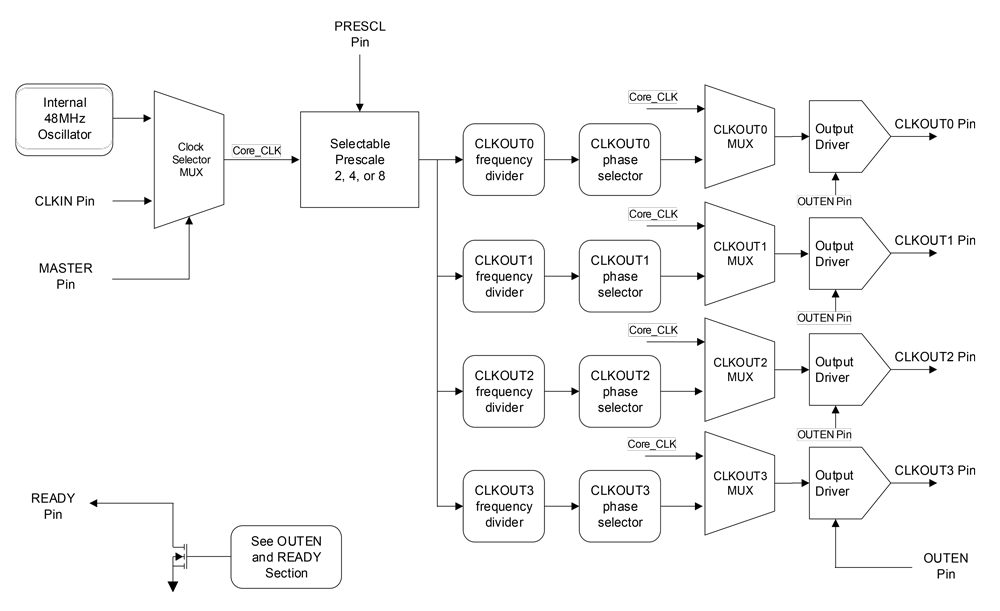
The ISL74420SLH is a radiation hardened, quad-output clock fanout IC with an optional internal 48MHz oscillator, tunable by ±10% using an external resistor. It is designed to deliver synchronization clocks for space-grade and high-reliability power systems and is particularly effective in multiphase power converters, where precise clock alignment and phase control are essential for optimal current sharing and reduced EMI.
Each output can be independently programmed with a unique frequency division and phase delay, enabling fine-grained timing control across multiple power stages. For applications that require more than four outputs, multiple ISL74420SLH devices can be cascaded, supporting scalable clock distribution across complex systems.
Configuration is supported via hardware selection pins or through an I²C/SMBus interface, offering both fixed and dynamic programmability to meet a range of design needs.
The ISL74420SLH is available in a 48-lead TQFP-EP hermetic package and is fully specified across the -55°C to +125°C temperature range, making it a robust solution for timing and synchronization in space and other mission-critical environments.
