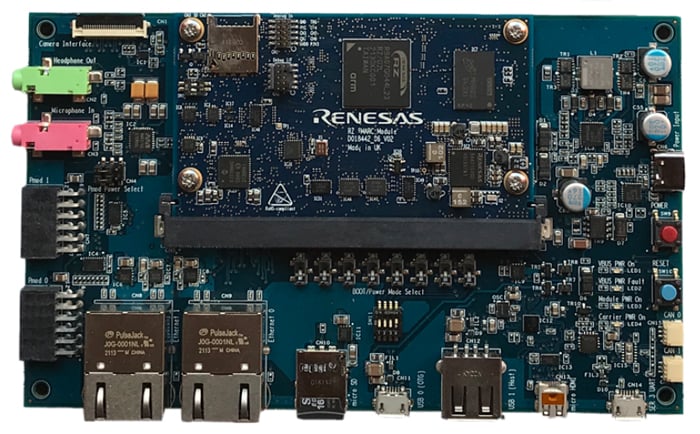
Accelerating Embedded HMI Development with the Renesas RZ/G2L MPU and Qt
Across medical and industrial applications, development teams are expected to deliver rich graphical user interfaces, shorten development cycles, ensure long-term availability, and prepare for future artificial intelligence (AI) capabilities—all at the same time. As a result, embedded human-machine interface (HMI) development is becoming more demanding than ever.
In this environment, choosing the right processor and UI framework has changed from a routine technical decision to a strategic choice that directly impacts product competitiveness, scalability, and lifecycle cost.
Here, we look at a real-world example from a Japanese medical device manufacturer that shows how the combination of Qt and the Renesas RZ/G2L microprocessor (MPU) accelerated the journey from evaluation to production.

The Challenge: An Aging Platform Meets New Requirements
The customer was developing a next-generation electrocardiograph and facing increasing demands for performance, connectivity, and long-term scalability. The existing platform could no longer provide sufficient CPU headroom, peripheral support, or a clear roadmap for future diagnostic capabilities.

Rather than exploring a like-for-like replacement, the team needed a platform that could support today's requirements while opening a path toward AI-assisted diagnostics and future feature expansion.
The Hardware Choice: Why Renesas RZ/G2L?
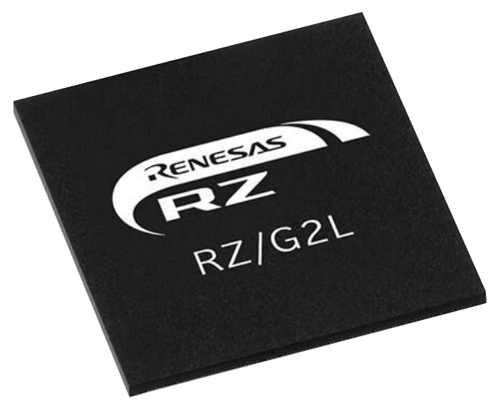
To meet these requirements, the team selected the Renesas RZ/G2L, a cost-optimized dual-core Arm® Cortex®-A55 MPU designed for embedded HMI and edge applications. The device integrates a Mali™-G31 GPU and an H.264 video codec, enabling rich graphics and multimedia performance within a constrained power and cost envelope.
Key decision factors included:
- Performance headroom and peripheral compatibility: RZ/G2L delivered a clear step up in CPU and graphics performance compared to the legacy platform, while maintaining compatibility with existing peripherals. This minimized redesign risk and helped protect the project schedule.
- A clear roadmap to AI: For future diagnostic ambitions, the migration path to Renesas RZ/G3E played a critical role. RZ/G3E builds on the same foundation with a quad-core Cortex-A55 CPU, Mali-G52 GPU, integrated H.264/H.265 codecs, and an Arm Ethos™-U55 neural processing unit (NPU). This roadmap ensured the team was selecting a platform capable of supporting the product's evolution over the next five years.
- Application engineering support: Early access to samples and evaluation kits (EVKs) allowed the team to begin prototyping without delay. When a mid-cycle issue arose, on-site support from Renesas application engineers helped resolve it quickly, preventing schedule disruption and reducing overall project risk.
Completing the Stack: Why Qt?
The team recognized that hardware alone does not deliver a production-ready embedded HMI. To fully leverage the capabilities of RZ/G2L and meet aggressive timelines, they required a mature and commercially supported software framework.
Qt provided a complete embedded UI solution validated for Renesas hardware. Using Qt Creator and the ready-to-run Qt Onboard package for RZ/G2L, built on a qualified Qt Board Support Package (QBSP), the team moved from evaluation to a realistic prototype with minimal environment setup.
GPU-accelerated rendering and integrated multimedia support allowed the application to fully utilize the RZ/G2L architecture, resulting in a responsive and polished user interface without extensive low-level development.
The Qt software stack used in this project included:
- Qt Creator IDE – End-to-end embedded development with cross-compilation and on-target debugging
- Qt Design Studio – Visual, component-based UI design with live preview on the target device
- Qt Quick/QML – Hardware-accelerated UI development with reduced implementation effort
For designs spanning MPUs and microcontrollers (MCUs), Qt for MCUs enables reuse of UI concepts and assets on resource-constrained devices. Furthermore, the Qt product portfolio supports a wide range of embedded use cases, with reusability across mobile, desktop, and web.
From Evaluation to Production, Faster
To simplify onboarding, the Qt Group has accelerated the evaluation process, reducing prototype development time from days to hours and providing the following benefits:
- A 90-day commercial evaluation of Qt Device Creation Enterprise
- Updated installer with direct access to packages validated for RZ/G2L
- Curated performance demos optimized for RZ/G2L
- Full technical support throughout the evaluation period
This approach enabled rapid progress from evaluation board to production-representative prototype, helping the team identify capability gaps early and before final licensing and hardware commitments.
By combining Renesas RZ/G2L hardware with the Qt software stack, the medical device modernized its HMI platform, reduced development risk, and established a clear path toward future AI-enabled functionality.
For development teams facing similar pressures of higher UI expectations, shorter schedules, and longer product lifecycles, this combination demonstrates how aligned hardware and software choices can accelerate time to market while preserving long-term flexibility.
Explore Qt for Renesas – Free 90-day Qt Evaluation for RZ/G2L-EVKIT