特性
- Single thermocouple interface
- Supports N-type thermocouples; additional thermocouple types on request
- Diagnostics for thermocouples
- Internal temperature sensor for cold-junction temperature compensation
- Digital compensation of offset, gain, and higher order nonlinearity as well as temperature coefficients of measured sensor input signals
- Operating temperature range: -40°C to 150°C
- Accuracy: ±0.25% FSO @ -40°C to 125°C
- NVM memory for configuration data, user-configurable measurement and conditioning function, and user-selected data
描述
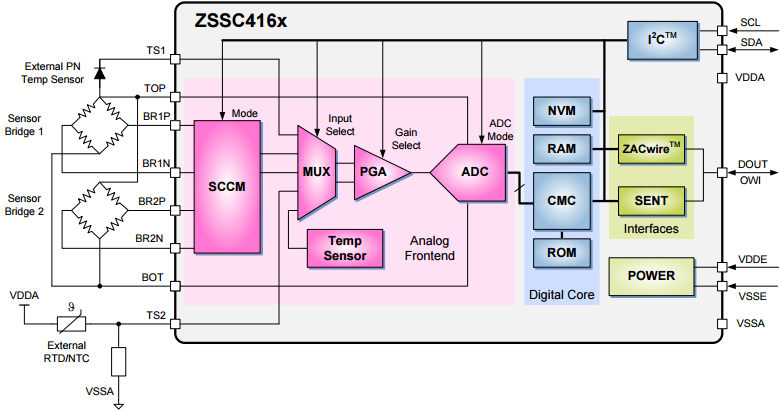
The ZSSC4171 is a member of IDT's ZSSC417x family of CMOS integrated circuits for highly accurate amplification and sensor-specific correction of voltage source sensor signals; e.g., thermocouple signals. The ZSSC4171 is designed for single thermocouple signals. Digital compensation of offset, sensitivity, temperature drift, and nonlinearity is accomplished with a 16-bit RISC microcontroller. Calibration coefficients and configuration data are stored in an integrated non-volatile memory (NVM), which is reliable in automotive applications. Measured values can be read via a digital SENT or I2C interface. The SENT interface enables transmission of sensor data via its fast channel as well as supplementary data via its Serial Data Message ("slow") channel using only one output pin. End-of-line calibration is supported via an I2C interface or via a One-Wire Interface (OWI) through the data output pin (DOUT). The ZSSC4171 and the calibration equipment communicate digitally, so the noise sensitivity is greatly reduced. Digital calibration helps keep assembly cost low as no trimming by external devices or lasers is needed. The ZSSC4171 is optimized for automotive environments by overvoltage and reverse polarity protection circuitry, excellent electromagnetic compatibility, and multiple diagnostic features.
当前筛选条件
筛选
软件与工具
样例程序
模拟模型
Modern vehicles are filled with complex sensor systems to achieve optimal performance and lower emissions. IDT's (acquired by Renesas) ZSSC416x and ZSSC417x family of sensor signal conditioner ICs are ideal for use in the engine and exhaust system. Sensing differential pressure at the mass airflow intake using a single IC attached to two sensors lowers power consumption and improves accuracy compared to traditional sensing systems. Manifold pressure and temperature sensing also benefit from using a dual input IC, with higher accuracy measurements resulting in a more optimal fuel mix.
The IDT ZSSC416x and ZSSC417x family of sensor signal conditioners provide a platform for measurement systems with improved accuracy, reliability, and performance with lower power consumption. The family of devices provides highly accurate amplification with integrated compensation, correction, and calibration, while also sharing a common four-millimeter by four-millimeter QFN package and toolset to reduce development and assembly costs.
Related Resources
ZSSC416X and ZSSC417X provide highly accurate amplification and calibrated correction of sensory data for resistive bridge and voltage source sensors. The family features SENT 3.0-based ICs and is designed for use in automotive applications. With available diagnostic info, rugged circuit protection, and excellent electromagnetic compatibility.
The family aids designers by lowering power consumption, reducing component count, and saving time spent calibrating sensors. Additionally, the availability of dual-bridge inputs also reduces system complexity and footprint. All of these are important considerations in modern automotive applications where power and space come at a premium.
Related Resources
SENT (Single Edge Nibble Transmission) is a unique serial interface/protocol originally targeted for automotive applications. Engineers are using this interface with sensors for applications such as throttle position, pressure, mass airflow, and high temperature. IDT provides sensor signal conditioners that function using the SENT interface.
The video reviews the three main SENT transmission protocols: fast channel read, short serial message format, and enhanced serial message format. It will cover the SENT signal's basic terms, definitions, and abbreviations, what is required to decode the SENT signal, and how to determine which SENT format applies to each application. It will cover the advantages of a SENT output vs. analog output and show an example of a sensor interface using SENT 3.0.
Related Resources
A brief introduction and overview of IDT's (acquire by Renesas) sensor signal conditioner evaluation kits. Evaluation kits generally consist of three parts: a communication interface board, a device board, and a sensor simulator board - all connected together. A sophisticated software GUI accompanies the kit, enabling an engineer to learn how to use the part rapidly, do quick prototyping, and practice calibrations.
Presented by David Grice, applications engineer at IDT. For more information about IDT's sensor signal conditioner products, visit the Sensor Signal Conditioner page.