跳转到主要内容
瑞萨电子 (Renesas Electronics Corporation)

Smarter Smoke Detection: How AI is Solving the Nuisance Alarm Problem and Reducing Costs

图像
Nalin Balan
Nalin Balan
Director of AI Core Technology Business Development
图像
Junyi Li
Junyi Li
Sr. Staff Engineer of Embedded Processing Product Marketing
发表时间:2026年7月22日

As communities grow and safety standards rise, reliable fire detection systems are becoming essential. Whether in commercial spaces or private homes, smoke detectors play a vital role in protecting lives and property.

With the smoke detection technology evolving, so do the expectations for how these systems should perform in real-world environments. Modern detectors need to be sensitive enough to catch early warning signs, yet efficient enough to operate reliably for years.

With that in mind, we’ve been exploring approaches that combine low-power hardware with intelligent signal processing, for instance, using the RL78/G22 MCU alongside TinyML models generated with Reality AI Tools®. Together, they enable detectors to recognize smoke patterns more accurately, identify anomalies, and ultimately support safer, more responsive designs, all while accelerating product development and integration.

Smoke Detector Solution

The common detection methods in smoke detection technology include photoelectric, ionization, and dual-sensor approaches. The Renesas solution adopts the photoelectric method, which is particularly effective for detecting early-stage slow-burning fires.

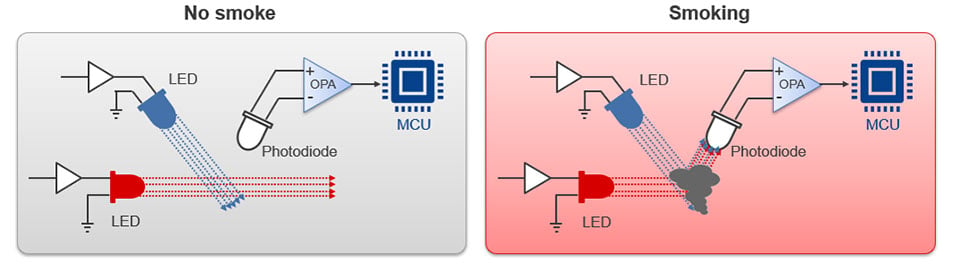
With recent revisions to the UL standard, specifically the inclusion of polyurethane fire and cooking nuisance tests, detection accuracy requirements have become significantly more stringent. To address these requirements, our solution uses a dual-wavelength LED sensing architecture. LED lights on different wavelengths have different scattering intensities depending on the size of smoke particles. As a result, the intensity of the optical signals detected by the photodiode is also different. With this characteristic, the solution can more accurately distinguish between smoke and cooking smoke.

图像
Graphic showing how to accurately distinguish between regular smoke and cooking smoke.
Figure 1. How to Accurately Distinguish Between Smoke and Cooking Smoke

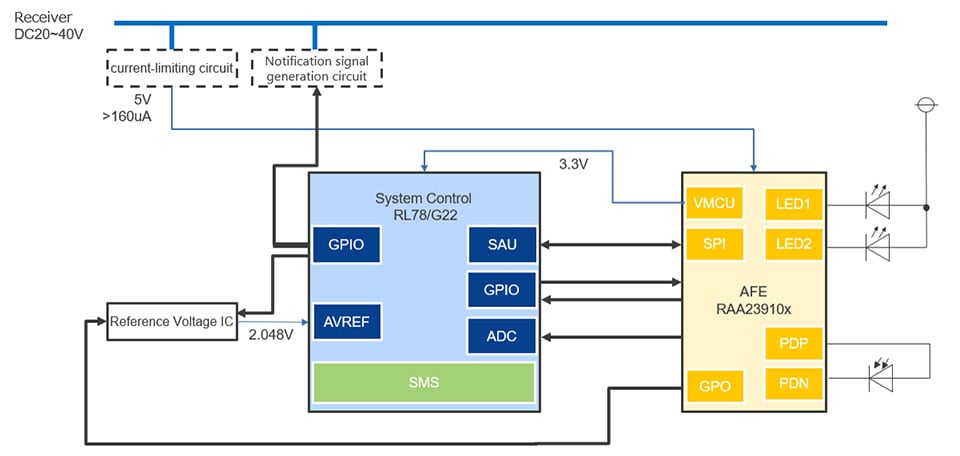
To implement this sensing architecture effectively, our solution adopts an integrated hardware design centered around the RL78/G22 MCU and an analog front-end (AFE) IC. Designed for conventional-type, commercial-use smoke detectors, the system operates with a 24V to 40V power supply. It incorporates a current-limiting circuit (≤160µA), as well as an external notification signal circuit to provide the following key advantages:

  • Energy-efficient system: The RL78/G22 MCU delivers industry-leading performance and low-power consumption. Deploying its built-in Snooze Mode Sequencer (SMS)¹ during standby periods enables the system to achieve increased energy efficiency and reduce standby current consumption by up to 20%.
  • Simplified and compact design: The combination of the MCU and AFE reduces the need for external components, enabling a more compact PCB footprint and streamlined design.
图像
Graphic showing the configuration for a smart smoke detector.
Figure 2. Smart Smoke Detector Configuration

AI-Powered Sensing with One Intelligent Sensor

The traditional approach of using two LEDs to classify smoke types with an effective algorithm after detecting and digitalizing the scattered LED lights, and the supporting driver circuitry works, but it adds cost and complexity to every detector. So, we stepped back and reconsidered the problem. Instead of asking how to manage two light sources, we asked a simpler question: could a single IR LED provide all the information a detector needs?

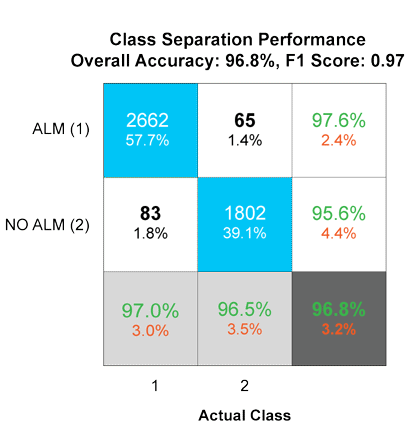
By leveraging edge AI, we can move beyond simple threshold detection, and instead of just looking at the amount of light scattered, our AI model analyzes the unique temporal signature of the signal. We gathered a broad dataset by putting our reference design through the full range of UL-specified scenarios, from smoldering wood and flaming polyurethane to common nuisance sources like cooking smoke (including the notorious "hamburger test"). Using this data, we trained a machine learning model that runs directly on the RL78/G22 MCU, enabling the system to distinguish the characteristic signal patterns of each event type.

The result is a detector that can interpret what it's sensing, rather than simply reacting to raw intensity changes, and can differentiate between a real fire and a false alarm with remarkable accuracy using only a single, low-cost IR LED.

图像
Chart showing LED current value detected by photodiode.
Figure 3. LED Current Value Detected by Photodiode
图像
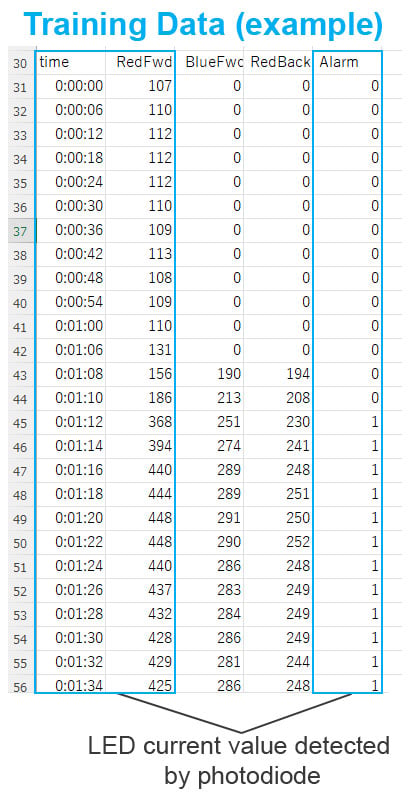
Screenshot of alarm detection validation metrics in Reality AI Tools.
Figure 4. Alarm Detection Validation Metrics in Reality AI Tools

Your Path to Smarter Fire Safety

The future of fire safety is not just about meeting standards; it's about building smarter, more reliable, and more efficient devices. By combining the industry's most efficient MCU with the intelligence of machine learning, the Renesas solution solves the core challenges of the new UL standards without compromising on cost or performance, enabling companies to focus on innovating the next generation of smoke detectors.

Ready to Learn More?

¹ Snooze Mode Sequencer (SMS): A feature that allows processing to be executed independently of the CPU.
² Data from the RL78/G22 Multiwavelength Smoke Detector Reference Design Application Note.

文档