

Business Responsibility
Human Rights | Supply Chain | Quality | Social Contribution | Participation in Initiatives
Our Commitment to Human Rights
Renesas is committed to respecting internationally recognized human rights, including those outlined in the International Bill of Human Rights and the ILO Declaration on Fundamental Principles and Rights at Work (Note 1). Recognizing these as minimum standards, Renesas conducts its business in alignment with the UN Guiding Principles on Business and Human Rights and supports the principles of the UN Global Compact. In cases where the laws and regulations of the country or region and the international standards on human rights are incompatible, Renesas will respect the international standards on human rights on the premise that we comply with the laws and regulations of the country or region. By aligning our operations with internationally recognized human rights standards, Renesas not only upholds its ethical responsibilities but also strengthens global trust, mitigates risk, and ensures sustainable growth across diverse markets.
Note 1: The international covenant on the Universal Declaration of Human Rights, and Civil and Political Rights, as well as the international covenant on Economic, Social and Cultural Rights
Human Rights Policy
Our human rights policy governs how we treat everyone - from our employees to our customers, communities and in our supply chain. Renesas has stated its commitment to respecting human rights in our Group Code of Conduct and in our Supplier Code of Conduct. Renesas Human Rights Policy was revised in May 2026 and clearly articulates our commitment to respecting and promoting human rights in all aspects of our operations.
Human Rights Governance
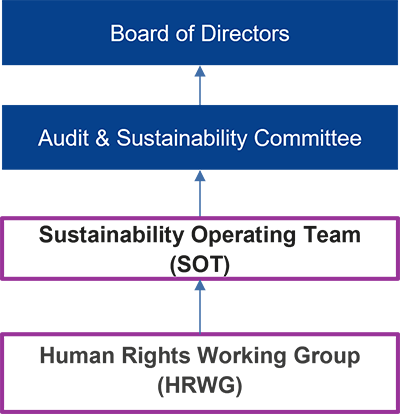
To enhance our human rights governance and reinforce the due diligence framework across the Renesas Group, we have established the Human Rights Working Group (HRWG)
- Renesas has established a human rights governance structure with the Board of Directors at the top, the Audit and Sustainability Committee (ASC) providing oversight, and the Sustainability Operating Team (SOT) serving as a cross-functional coordinating body. The Human Rights Working Group (HRWG), as an operational-level body, holds regular meetings to review newly emerging risks, monitor the progress of existing initiatives, and coordinate necessary actions, including remediation and stakeholder engagement.
- Through this governance structure, we aim to enhance our organisational capability to address human rights issues in a systematic and transparent manner. The HRWG also works to ensure alignment with internationally recognised standards—such as the Guiding Principles on Business and Human Rights and the OECD Guidelines for Multinational Enterprises.
Human Rights Due Diligence & Risk Assessment
Following a self-assessment questionnaire, done in partnership with the Business for Social Responsibility and with support from PwC, we identified the following six key human rights risks within our major entities, both within the company and our supply chain:
- Safe and Healthy Working Environment
- Prohibition of Child and Forced Labor
- Working Hours
- Responsible Minerals Procurement
- Labor-Management Relations (Japan)
- Human Rights Education
To uphold our high ethical standards and meet stakeholder expectations in these critical areas, Renesas conducts ongoing, risk-based human rights due diligence (HRDD) in line with the United Nations Guiding Principles on Business and Human Rights. Through this process, we identify, assess, prevent, and mitigate actual or potential adverse human rights impacts across our own business operations and value chain, and communicate how we address them.Risks are prioritized based on their severity, including the scale, scope, and irremediability of the impact, as well as their relationship to Renesas, namely whether we caused or contributed to the impact, or are directly linked to it through our business relationships. Where Renesas has caused or contributed to an adverse human rights impact, we seek to provide or cooperate in appropriate remediation.
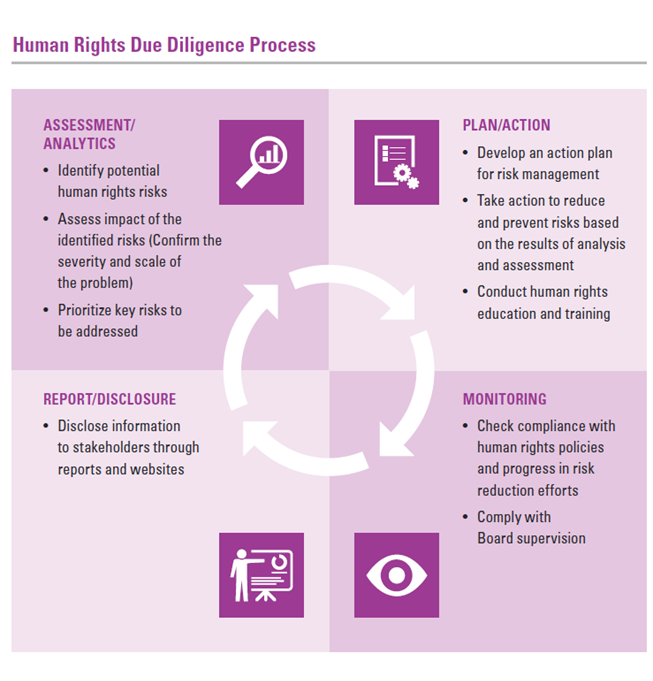
Our human rights due diligence process includes:
- Annual human rights risk assessments across our own operations and supply chain
- ESG self-assessments (SAQs) for suppliers
- Identification of concerns through our grievance mechanisms and stakeholder engagement
The results are consolidated and reported in line with our internal governance structure, and are reviewed by the Sustainability Operating Team (SOT) and the Audit and Sustainability Committee (ASC).
Initiatives to Respect for Human Rights
Following the identification of six key human rights issues to be addressed within the Group and our supply chain,we will take additional steps to identify, prevent and mitigate risks in accordance with the United Nations Guiding Principles on Business and Human Rights.
1. Safe and Healthy Working Environment
In accordance with “Basic Policy on Disaster Prevention, Health and Safety,” Renesas is working as one group to ensure the safety and health of our employees and maintain a safe and comfortable work environment and business operations.
With the global goal of “zero work-related accidents,” we are committed to identifying hidden risks and maintaining the workplace where Renesas employees and contractors work safely and in good health.
Learn more about Safe and Healthy Working Environment
2. Prohibition of Child and Forced Labor
At Renesas we are committed to maintaining the highest possible ethical standards in all aspects of business operations. We recognize our responsibility to uphold human rights and ensure fair labor practices. We do not engage in forced labor, child labor or human trafficking in any of our business activities.
In addition to company-owned facilities, our global suppliers are also required to comply with these obligations. The Renesas Supplier Code of Conduct stipulates our strict prohibition of child labor and forced labor.
Our commitments include the following measures:
- We implement thorough and stringent employment verification processes to ensure that all workers meet the legal working age requirements. This includes detailed documentation reviews and age verification procedures. Our recruitment practices expressly preclude any form of forced labor or human trafficking which we enforce through strict oversight of employment practices in all the countries in which we operate.
Renesas Electronics Group Human Rights Policy
Renesas Supplier Code of Conduct
Renesas publishes its UK Modern Slavery Statements to provide transparency on the steps taken to prevent and address modern slavery risks across its operations and supply chain.
3. Working Hours
Renesas complies with the laws and regulations of each country. We properly manage working hours, holidays, and vacations to create an environment where our employees can work in good physical and mental health.
- In line with our Action Policy of “maintaining a work environment that respects work-life balance,” we promote ongoing efforts to reduce long work hours, encourage employees to utilize their planned annual paid leaves, and promote activities emphasizing “mental and physical health for employees.”
Learn more about Creating a Pleasant Workplace Environment
4. Responsible Minerals Procurement
To prevent human rights violation related to mineral procurement, we are working on responsible mineral procurement with a goal to source materials that does not contain conflict minerals.
Renesas is a member of the "Responsible Mineral Procurement Study Group" established by the Japan Electronics and Information Technology Industries Association (JEITA) to practice responsible mineral procurement. We are a member of Responsible Minerals Initiative (RMI), which promotes responsible mineral procurement worldwide. By participating in the "Responsible Minerals Procurement Study Group" in collaboration with RMI, we aim to increase cooperation within the semiconductor industry and address conflict minerals issues such as the identification of smelters and refineries.
Renesas Electronics Group Human Rights Policy
Learn more about Responsible Minerals Procurement Policy
Renesas Responsible Minerals Procurement Policy
5. Labor-Management Relations (Japan)
Renesas respects the rights of employees to form and join trade unions and to engage in collective bargaining, in accordance with local laws. The company does not discriminate against employees based on union membership or participation in union activities.
In Japan, where union formation is permitted, eligible employees below the managerial level are members of the Renesas Group Labor Union Confederation, with certain exceptions such as HR and corporate planning personnel, as designated by the union.
Renesas and the union have entered into labor agreements in line with Japan’s Labor Union Law, based on mutual respect, sincerity, and trust. Both parties are committed to upholding their responsibilities in good faith to ensure constructive labor-management relations.
6. Human Rights Education
As part of our ongoing investment in human rights, we are establishing a dedicated working group alongside the rollout of a global learning management system (LMS). This integrated approach provides an opportunity to align our training content with the latest standards and best practices, ensuring that employees across all regions receive consistent, up-to-date guidance. Training completion data will support transparency and demonstrate our commitment to embedding human rights principles throughout the organization.
Ongoing and Future Initiatives
In parallel, we are actively developing a comprehensive, longer-term strategy to ensure sustained progress in this area and alignment between our human rights practices with global best standards and our organizational objectives.